The padel racket guide: every spec explained
Shape, balance, weight, materials, core, surface, frame, sweet spot, stiffness and the brand technology names you see on racket pages. What each one means and how it changes your game, in plain language.
16 min read · Updated 11 Oct 2026
A padel racket is a solid, perforated paddle: two thin skins (the faces) glued over a foam or rubber core, held in a hollow frame, with a short handle. Every racket follows that recipe, so the differences come from a handful of choices: the outline of the head, where the weight sits, what the skins and core are made of, and how the face is finished. This guide walks through each one, what it does on court, and how to read it on a racket page.
Shape: round, teardrop and diamond
The outline of the head decides where the sweet spot sits and, together with the frame, how the weight is spread. It is the first spec most players look at, and with good reason.
| Shape | Sweet spot | Feels like | Usually suits |
|---|---|---|---|
| Round | Low, central and large | Forgiving and easy to place; less free power overhead | Beginners, defenders, control players |
| Teardrop | Slightly higher, medium size | The middle ground: more reach and punch, still fairly forgiving | All-round players who attack and defend |
| Diamond | High, nearer the tip, more compact | Leverage for smashes; punishes off-centre hits | Advanced attackers with fast, clean swings |
| Hybrid | Between teardrop and diamond | Most of a diamond's punch with a little more forgiveness | Attacking players who want some margin |
Balance: low, medium and high
Balance is the point along the racket where it would balance on your finger. It is quoted either as a category (low, medium, high) or as a distance in millimetres from the butt cap. Two rackets with the same weight can feel completely different because of it.
- Low balance (head-light): the weight sits towards your hand. The racket feels quick, is easy to bring into position for volleys and defence, and is kinder to the elbow and shoulder. You give up some free power on smashes.
- Medium balance (even): neutral. Neither sluggish nor whippy, which is why it is a common choice for all-round players.
- High balance (head-heavy): the weight sits towards the tip. Swings carry more momentum, so smashes and hard volleys come off with more pace. It is slower to react in quick exchanges at the net and puts more load on the arm.
Where brands publish a number, most rackets in our catalogue sit between about 250 and 275 mm from the butt cap; a higher number means more head-heavy. Categories are not standardised between brands, so a millimetre figure is more useful than a word when you can get it. An overgrip lowers the balance slightly; tape or weights at the head raise it.
Weight
Most adult rackets weigh between about 345 and 380 g, and brands usually quote a range (for example 360–375 g) because no two frames come out of the mould identical.
| Weight | What it gives you | What it costs |
|---|---|---|
| Light, under about 355 g | Fast hands, less fatigue, easier on the arm | Less stability against hard balls; less mass behind the ball |
| Medium, about 355–368 g | A balance of stability and speed most adults handle comfortably | A compromise, by definition |
| Heavy, 368 g and up | Stability, a solid feel and more pace on the ball | Slower to manoeuvre and more tiring over a long match |
Weight and balance work together. A light racket with a high balance can feel heavier in the hand than a heavier, head-light one, because what you feel when you swing is how far the mass sits from your hand. Judge them as a pair.
Face materials: carbon, fibreglass and blends
The faces (the skins either side of the core) are layers of woven fibre set in resin. The fibre type has a big effect on feel.
Fibreglass
Glass fibre is more flexible than carbon. A fibreglass face bends more at impact, which gives easy depth on slow shots, a softer and more comfortable feel, and usually a lower price. It is less crisp on very fast swings.
Carbon fibre
Carbon is stiffer and lighter for its strength. Carbon faces feel more precise and return more energy when you swing fast, which is why most advanced rackets use them. They also pass more vibration to the arm and need more swing speed to come alive.
What "3K", "12K" or "18K" means
The K number is how many thousand carbon filaments are bundled into each strand of the weave: 3K is 3,000 filaments, 18K is 18,000. Higher K strands are thicker and flatter, and brands often pair them with a stiffer feel. But the K count alone does not measure stiffness: the number of layers, the resin and the core matter at least as much. Treat it as one clue, not a verdict.
Other face treatments you will see
- Aluminised ("Alum") carbon or glass: fibre with an aluminium coating. Brands describe it as adding stiffness and a distinctive look. How much it changes play is hard to separate from the rest of the layup.
- Spread-tow carbon (sold under names such as Textreme): carbon spread into thin, flat tapes instead of round bundles, which makes a thinner, lighter laminate for the same stiffness.
- Hybrid faces: carbon and fibreglass layered together, aiming for some of carbon's precision with some of glass's comfort.
- Brand-named fibres: many brands sell their own fibre blends under trade names. The name alone does not tell you the recipe, so check what the brand lists on the racket page.
Core and foam
Between the faces is a core, almost always EVA rubber or a softer polyethylene foam, filling the racket's 38 mm thickness. How firm that core is changes how the ball leaves the face more than almost anything else.
| Core | Feel | Power | Control and comfort |
|---|---|---|---|
| Soft EVA / foam | The ball sinks in, then springs off | Easy depth on slow balls; less on very fast swings | Very comfortable; less precise at high speed |
| Medium EVA | Balanced | Some help on slow balls, holds shape on fast ones | The sensible default for most club players |
| Hard EVA | Firm, crisp, little give | Strong on fast swings; slow balls need effort | Very precise; more vibration reaches the arm |
- Foam vs EVA: polyethylene foam is softer and livelier than EVA rubber, so the ball comes off easily, but it tends to lose its bounce sooner.
- Multi-density cores: several layers or zones of different EVA densities, often a firmer outer layer for precision with a softer inner one for comfort. Brands sell these under their own names (for example MultiEVA, HR3 or Power Foam on racket pages in our catalogue).
- "Memory" or "high-memory" EVA: a slower-recovering rubber that brands describe as adding control and comfort.
- Core names on their own are marketing: the useful information is the hardness the brand gives (soft, medium, hard), which we show on each racket page when it is published.
Surface and face finish: smooth, rough and 3D
The outside of the face can be finished in different ways, and the finish changes how much grip the face has on the ball.
| Finish | What it is | Effect on spin |
|---|---|---|
| Smooth | A flat, untextured face | Clean, predictable contact; least grip for spin |
| Sand / grit | Fine grit set into the paint or resin | More grip with a soft touch; the grit wears down with use |
| Rough | A textured surface | Grips the ball for slices, kick serves and viboras |
| 3D relief | A raised pattern moulded into the face | The most bite on the ball for players who rely on spin |
Texture helps you put spin on the ball; it does not create spin by itself. Your swing does that. Gritty finishes also wear smoother over time, so a well-used racket may grip less than a new one.
Frame and construction
The frame is the hollow tube around the edge of the head, continuing into the throat and handle. It holds the faces in shape and carries much of the racket's stiffness.
- Frame material: usually carbon fibre (stiffer and lighter), sometimes fibreglass or a composite. Some brands add aramid (the fibre family that includes Kevlar) for toughness and damping, or small amounts of graphene, which brands describe as adding strength.
- Tubular construction: the frame is a hollow tube. "Double tubular" frames use two tubes or a reinforced tube for extra rigidity and stability on off-centre hits.
- Frame profile: the cross-section (round, oval, faceted) changes how the frame cuts through the air and how stiff it is.
- Edge guard (protector): a rubber or plastic strip over the top of the frame that takes knocks from the floor and walls. It protects the frame but adds a few grams at the head.
- Throat and bridge: the area where the head meets the handle. An open throat with a bridge saves weight and lets air through; a closed or solid throat adds stability.
Durability
Most racket damage comes from hitting the floor or walls, and from heat: leaving a racket in a hot car can soften the core and resin. Use the edge guard (and protector tape if you scrape the ground often), store it in a cover at room temperature, and expect a racket played several times a week to lose some liveliness within a season or two as the core and faces fatigue.
The sweet spot
The sweet spot is the part of the face where impact gives the best result: the most ball speed and the least vibration in your hand. Hits outside it lose pace and twist the racket in your hand.
- Location: set mostly by the shape. Round rackets keep it low and central; diamonds push it towards the tip, where you have more leverage but also further to reach.
- Size: a bigger sweet spot forgives off-centre contact, which is why round, head-light rackets are recommended for beginners.
- What influences it: the head shape and width, the balance, the frame's stiffness and the hole pattern. Some brands drill more holes or vary the core in the hitting zone to enlarge or move it.
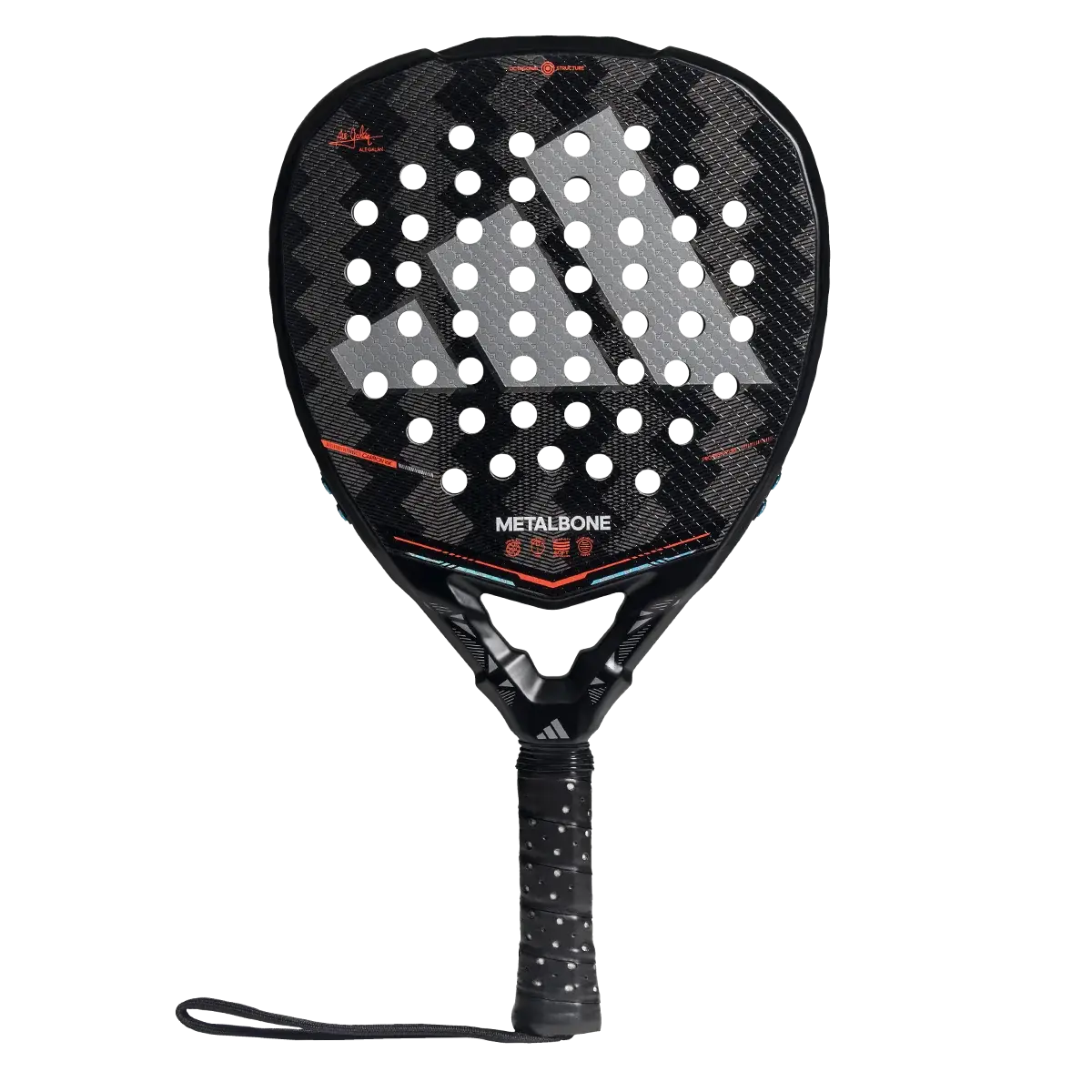
adidas Metalbone 3.4, diamond shape. Platform-created model. 3D model built by Paladex to represent this racket. Not supplied by the manufacturer. Use the arrow keys to rotate, plus and minus to zoom and R to reset. The buttons below the model switch between front, back, edge, top, grip and detail views.
Power and control
Every racket trades power against control to some degree, and the specs above are the levers.
| More power usually comes from | More control usually comes from |
|---|---|
| Diamond or hybrid shape | Round or teardrop shape |
| High balance (head-heavy) | Low or medium balance |
| More weight | Lighter, quicker weight |
| A hard core and stiff carbon face (on fast swings) | A softer or medium core with a forgiving face |
| A soft core (on slow swings, where it adds rebound) | A larger, more central sweet spot |
Note the soft-core entry on both lists: soft cores add easy depth on slow shots but feel less precise on fast ones, while hard cores do the opposite. Power therefore depends on how fast you swing. A good rule: choose control first while your technique is developing, and add power once you consistently hit the sweet spot.
Stiffness and flexibility
Stiffness is how much the racket face and frame bend at impact. It comes from the face material (carbon is stiffer than glass), the number of layers, the core's hardness and the frame.
- Stiffer rackets feel precise and direct, return more energy when you swing fast, and pass more vibration to the arm.
- More flexible rackets bend more and release the ball like a trampoline, which helps on slow balls and is more comfortable, but feels less exact on hard hits.
- Brands rarely publish a stiffness number for padel rackets, so it is usually judged from the materials and core hardness. Our pages show those specs rather than guess a figure.
Holes, thickness and dimensions
Padel rackets have limits set by the sport's federations. Under the International Padel Federation (FIP) rules, a racket may be at most 45.5 cm long, 26 cm wide and 38 mm thick, and the holes in the hitting area must be between 9 and 13 mm across. Weight is not limited.
- Thickness: almost every racket is 38 mm. A few are slightly slimmer for a quicker feel.
- Holes: they cut weight and air resistance. The pattern and number vary by model, and some brands concentrate holes where they want the sweet spot.
- Handle: most handles are a similar length and thickness. Grip size is adjusted with overgrips, and the wrist cord is part of the rules, so wear it.
Comfort and adjustable systems
- Anti-vibration systems: some rackets include rubber or elastomer inserts in the throat or handle to absorb vibration. Brands give them their own names; the effect is mostly on comfort.
- Adjustable weights: some models let you add or move small weights to change the balance. Useful if you want to fine-tune one racket rather than buy another.
- Overgrips: thin wraps over the handle that add grip, a few grams near your hand and a slightly thicker handle. Change them often.
Technology and brand names
Racket pages are full of trademarked names for cores, fibres, textures and frames. They are useful for telling models apart, but each name belongs to one brand and describes that brand's version of a common idea. A quick way to decode one is to ask which category it belongs to:
- Core names
- Names that end in EVA, Foam or Core (such as MultiEVA, Power Foam, Control Foam or HR3 on pages in our catalogue) describe the brand's core rubber or foam. Look for the hardness the brand gives alongside it.
- Fibre and face names
- Names with a K number, "Carbon", "Glass", "Alum" or a fibre trade name describe the face layup. Fibreglass-based blends feel softer; carbon-based ones feel crisper.
- Texture names
- Names with Spin, Grit, 3D or Rough describe the face finish: how much the surface grips the ball.
- Frame names
- Names with Tubular, Frame or Structure describe the frame's construction or reinforcement.
- Weight and comfort systems
- Names for adjustable weights, anti-vibration inserts or handle systems. They change how the racket can be tuned or how it feels, not its basic character.
Two rackets that use similar-sounding technology can still play differently, and not every racket uses every technology. When we show a technology on a racket page, it is because the brand lists it for that racket.
Level, style and reading a racket page
| Beginner | Intermediate | Advanced | |
|---|---|---|---|
| Shape | Round | Round or teardrop | Any, often diamond for attackers |
| Balance | Low or medium | Medium | Medium to high |
| Weight | About 345–365 g | About 355–370 g | Personal preference |
| Core | Soft or medium-soft | Medium | Medium to hard |
On each Paladex racket page you will find the brand's published specs, marked as checked against the brand or as unverified when a value came from a retailer. Our power, control and other scores are Paladex's sample evaluations, derived from those specs, not lab measurements. Where a spec is not published, we say so instead of filling it in.
Quick glossary
- Balance point
- Where the racket balances, in mm from the butt cap. Higher means more head-heavy.
- Butt cap
- The end of the handle.
- Core
- The foam or EVA rubber between the two faces.
- EVA
- Ethylene-vinyl acetate, the rubber used in most cores. Sold in different densities.
- Face
- The two hitting surfaces either side of the core.
- Frame
- The hollow tube around the head, throat and handle.
- Layup
- The stack of fibre layers and resin that makes up a face.
- Sweet spot
- The area of the face that gives the best rebound and least vibration.
- Throat / bridge
- Where the head joins the handle, open or closed.
- Vibora and bandeja
- Overhead shots hit with slice; textured faces help with both.